
✧ co-first author | Three-Dimensional Magnetotelluric Forward Modeling Through Deep Learning
Published in IEEE Transactions on Geoscience and Remote Sensing, 2024
Abstract
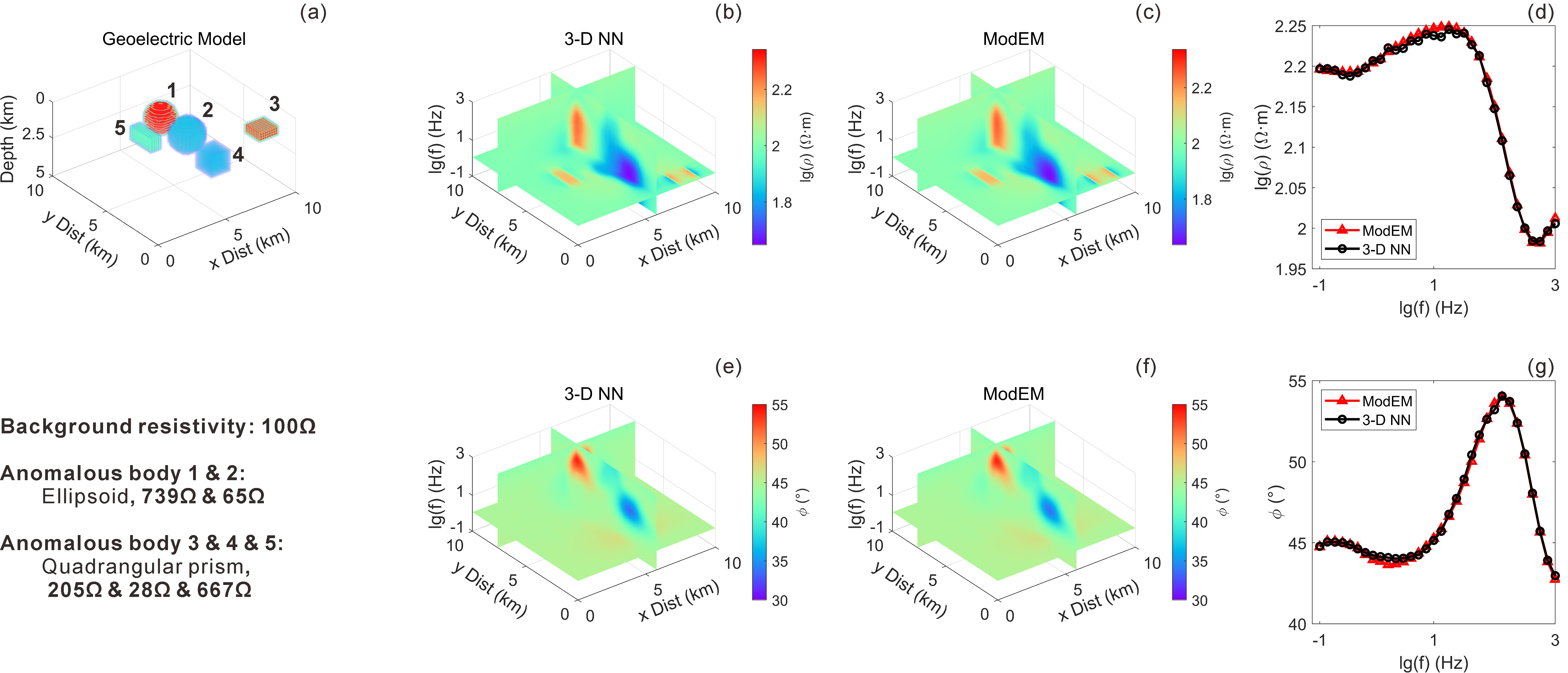
For a long time, the 2-D and 3-D magnetotelluric (MT) forward modeling is mainly accomplished by computational methods. Traditional methods are time-consuming due to the large amounts of discrete grids and slow solution of the matrix equation. Therefore, finding a fast forward modeling algorithm remains a major concern. In recent years, deep learning has provided new ways to accomplish this goal. Most existing deep-learning-based MT forward modeling models are performed on 2-D data, and there is a lack of research on the feasibility of 3-D problems. This article constructs a large-scale 3-D MT dataset, uses a deep neural network (NN) suitable for 3-D MT data patterns, and improving the training efficiency through a transfer learning strategy for similar tasks, which can predict the apparent resistivity and phases in different polarization directions, and realizes fast and high-precision 3-D MT deep learning forward modeling. The experimental quantitative metrics show that the mean relative errors (MREs) of apparent resistivity and phase are 0.6042% and 0.2423%, respectively, and the mean absolute errors (MAEs) are 1.6726 and 0.0994, respectively. When applying the method to geoelectric models that are more complex than the training set, accurate forward modeling results validate its generalization ability. The research may provide methodological and data support for large-scale 3-D MT forward modeling in the future.
Paper
Three-Dimensional Magnetotelluric Forward Modeling Through Deep Learning
Result
Dataset
The dataset is available at here.
Cite
if this work is helpful for you, please cite
@ARTICLE{10530923,
  author={Wang, Xuben and Jiang, Peifan and Deng, Fei and Wang, Shuang and Yang, Rui and Yuan, Chongxin},
  journal={IEEE Transactions on Geoscience and Remote Sensing},
  title={Three-Dimensional Magnetotelluric Forward Modeling Through Deep Learning},
  year={2024},
  volume={62},
  number={},
  pages={1-13},
  doi={10.1109/TGRS.2024.3401587}}